


Creatine
Where Does Your Creatine Come From? What the Label, the Seals and a Certificate of Analysis Can Tell You
A creatine label has to name who sells the tub, not who made the creatine inside. Here is what the label, the seals and a certificate of analysis can tell you, and three questions to ask about any tub.

A creatine label has to name who sells the tub, not who made the creatine inside. Here is what the label, the seals and a certificate of analysis can tell you, and three questions to ask about any tub.
At a glance
- Your body makes some creatine, and meat and fish supply more. The creatine in a supplement is made in a chemical plant, by synthesis.
- A US supplement label has to name the brand and its address. It doesn’t have to name the company that made the creatine.
- Quality seals such as NSF, USP Verified and Informed Sport check what is in the product. On the certifiers’ own descriptions, none of them tells you who made the creatine, or where.
- A certificate of analysis for your lot is where purity shows up: assay, creatinine, dicyandiamide, dihydrotriazine and heavy metals.
- Quality varies from maker to maker and lot to lot, wherever creatine is made. So ask three questions: who made it, in which country, and is there a certificate of analysis for your lot?
Where does creatine come from?
Start with your own body. Your liver and kidneys make some creatine every day, and meat and fish supply more.1 We list the foods, and how much you’d have to eat, in foods high in creatine.
The creatine in a tub is a different story. It is made in a chemical plant, by synthesis, usually from two starting chemicals, sarcosine and cyanamide.2,3 So when you ask where your creatine comes from, there are two answers worth having: which company made it, and in which country. The label is the first place to look, and it may not tell you either one.
Where most of America’s creatine ships from
Official US trade statistics can’t count creatine on its own, because it shares a catch-all customs code with other chemicals. So we read US customs shipping records and counted the shipments ourselves.
That 93% is 86% traced to China, plus 7% that left Busan, South Korea, with the shipper’s name withheld, an option importers can lawfully request. We found no creatine maker in South Korea, and every Busan shipment that names a maker names a Chinese one, so we count them as China. The method, the yearly data and the charts are in where America’s creatine ships from.
What the video shows: An animated map of the United States fills with dots, one for each 0.2% of 2025’s bulk creatine tonnage shipped in by sea: 93% China, 6.5% Germany. A line chart then shows 2026 imports passing the 2025 total by mid-October.
None of this means creatine made in China is a problem. Some creatine from China is perfectly acceptable. With about 93% of 2025’s bulk creatine by sea shipped from China, most of it comes from makers there, and the label doesn’t have to name which one.
What a creatine label has to say, and what it doesn’t
A US supplement label has to name the company that made, packed or distributed the product, with its address. That line can read “Distributed by” or “Manufactured for,” and the address can be the brand’s main office. It doesn’t have to be where the product was made, and it doesn’t have to name the company that made the creatine.4,6 The Supplement Facts panel tells you what is in a serving and how much. It doesn’t have to say where any ingredient was made.5
| Required by FDA’s label rules | Not required by FDA’s label rules |
|---|---|
| The name and address of the company that made, packed or distributed the product. It can read “Distributed by” or “Manufactured for.” | The name of the company that made the creatine. |
| Each dietary ingredient and how much of it is in a serving. | Where any ingredient was made. Whether the country has to appear depends on customs rules. |
| The words “dietary supplement.” | Test results, or a certificate of analysis for the lot. |
Country of origin is a separate question, and it comes from customs law, not from FDA’s label rules. FDA’s labeling guide points supplement companies to it: imported goods have to show the final US buyer where they were made. But when an imported ingredient is made into a new and different product in a US factory, customs can treat that factory as the final buyer, and the finished label may not have to say where the ingredient came from. Which side of that line a tub of creatine falls on is decided case by case.6,7,8
The government does see the maker at the border. Importers of food and dietary ingredients have to tell FDA the manufacturer and the country of production before a shipment arrives.9 That record just isn’t printed for shoppers. Some labels do name the maker, often through a branded ingredient whose maker is public. Not every label does.
What quality seals check, and what they don’t
Every brand starts from the same legal floor. FDA’s manufacturing rules require each company to run an identity test on each dietary ingredient, set its own limits for purity, strength and contaminants, and check finished batches against them, either every batch or a sampled subset.10 A quality seal is a voluntary layer on top of that.
Seals answer a useful question: is what’s on the label in the product, and is it free of contaminants or banned substances? They aren’t designed to answer a different one: who made the creatine, and where. On the certifiers’ own descriptions, none of them tells a shopper that.
| Seal or claim | What it checks | Names the maker or country? |
|---|---|---|
| NSF Contents Certified (NSF/ANSI 173) | Label claims, a toxicology review of the ingredients added on purpose, and a screen for undeclared ingredients and contaminants. Yearly audits and periodic retests. | No |
| NSF Certified for Sport | Adds a screen of production lots for substances banned in sport. NSF lists the lots it tested online. | No |
| NSF GMP certification (NSF/ANSI 455-2) | An audit of the facility's manufacturing practices. It is not a test of the product in a particular tub. | No |
| USP Verified | The listed ingredients in the declared amounts, no harmful levels of the contaminants USP checks for, made under federal manufacturing rules, and breaks down within a set time. USP also retests products bought off the shelf. | No |
| Informed Sport and Informed Choice | A screen for substances banned in sport: every batch for Informed Sport, sampled batches for Informed Choice. | No |
| “Third-party tested” | Not a standard. Ask which lot was tested, for what, and whether the results are published. | No |
Summaries of each program’s own public description, checked 31 October 2026. Each program’s full scope is on its own site. None of these programs certifies ThriveOn Creatine as a product.
The National Institutes of Health’s Office of Dietary Supplements says quality seals indicate a product was properly made, contains the ingredients listed and doesn’t contain harmful levels of contaminants. What each mark covers varies, and none of them guarantees a product is safe or effective.11 To check a seal, look the product up on the certifier’s own site. We go through each badge in more detail in what NSF, Informed Sport and GMP actually mean.
What the video shows: Creatine, then and now: creatine used to be a few weeks before the season; now it’s 5g a day, for years, so what else is in your tub matters. Where it’s made: there’s no American-made creatine; nearly all of it is made in China or Germany. Think of a tomato: from your garden, you know the soil, the water, what was sprayed; a store tomato can pass an inspection, and you still don’t know any of that. Then known against unknown. Who made it: Alzchem, for more than 30 years, against “You can’t check.” How it’s purified: in water, no organic solvents, no acid, against water, acid or solvents, depending on the maker. Batch to batch: one process, one spec, every batch, against “You can’t tell.” Both can pass a test. Only one tells you how it was made. Some creatine from China is perfectly acceptable. You just can’t tell which. Testing is good. Knowing how it’s made is better. The end card: ThriveOn Creatine has both: German-made Creavitalis® from Alzchem, and every lot tested by an independent lab.
What a certificate of analysis shows
A certificate of analysis, or COA, is a lab report for one lot. It lists what was tested, the limit each result had to meet (often called the specification) and the result itself. It is the one document that can speak to the purity of the tub in your hands, as long as its lot number matches the one printed on your tub. For creatine, five lines matter most.
| On the certificate | What it measures | What a high reading would mean |
|---|---|---|
| Assay | How much of the powder is creatine, given as a percentage. | A result below the specification means less creatine in each serving. |
| Creatinine | What creatine turns into with heat or moisture. Your body makes it every day too. | Mainly a little less creatine per serving, and a sign the powder was not handled gently. |
| Dicyandiamide (DCD) | A by-product that forms when cyanamide, one of the starting chemicals, pairs with itself. | It has low toxicity in animal studies, so a high reading says more about how carefully the powder was made and washed than about a known health risk. |
| Dihydrotriazine (DHT) | A by-product that depends on how the sarcosine raw material was made. | Its health effects are unknown, so the tightest specifications call for it to be undetectable. |
| Heavy metals | Lead, arsenic, cadmium and mercury. | Metals are tested because they can come in with raw materials. Each has its own limit. |
Assay is the one line where a higher number is better.
There is no single US legal limit for these by-products. Each company sets its own specifications under FDA’s manufacturing rules.10 For a sense of scale, according to Alzchem’s GRAS notice to FDA, which summarizes a 2004 opinion from Europe’s food safety authority, the creatine assessed then contained no more than 100 mg/kg creatinine and 50 mg/kg dicyandiamide, with no detectable dihydrotriazine, while Denmark’s national specification allows up to 1,000 mg/kg creatinine.3,13
The study, from the University of Udine, found creatinine was the main by-product. The highest dihydrotriazine reading was 8.0 mg/kg. Of four heavy metals, only mercury was found, below 1 mg/kg. The study names no country, maker or brand, and the samples are about 15 years old.12
Reading one takes a minute. Check that the lot number matches your tub. Check the date. Check who issued it: the company that made the creatine, the brand, or an independent lab. Then check that each result sits inside its limit. If an independent lab ran the test, it’s fair to ask whether that test is on the lab’s ISO/IEC 17025 accreditation, because that accreditation covers specific tests, not everything a lab does. We show a real certificate, and how to ask a brand for one, in how to tell if your creatine is real.
Ask us for ours.
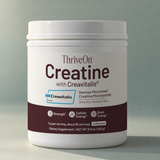
ThriveOn Creatine is Creavitalis® creatine monohydrate, made by Alzchem in Trostberg, Germany, and packaged in the USA. Send us your lot number and we’ll send you the certificates we have for it.
If creatine upsets your stomach
When creatine upsets the stomach, the best-documented factor is serving size. In a 28-day double-blind trial in 59 soccer players, 55.6% of those taking one 10g serving a day reported diarrhea, against 28.6% on two 5g servings and 35.0% on placebo.14 Early water weight is more common with a loading phase.1 So smaller servings may help, and a loading phase is optional.
We found no published human study testing whether impurities contribute to stomach upset. If symptoms continue, stop taking it and ask your doctor. Purity is a separate question, and the certificate of analysis for your lot is where to check it.
Three questions to ask about any tub of creatine
What the video shows: On a cream background: “Some creatine from China is perfectly acceptable. Not every label names the maker.” Then: “Does your label say where the creatine was made?” The end card gives the address for the full method and data, and says ThriveOn sells German-made creatine from Alzchem.
Before you buy, ask
- Who made the creatine? Not who sells the tub: the company that made the creatine inside it.
- In which country?
- Is there a certificate of analysis for your lot? And does its lot number match the one printed on your tub?
A label has to name who sells the creatine. A seal tells you what was checked. A certificate tells you what is in your lot. Who made the creatine, and where, is a question any brand can be asked.
Our answers
Here are ours, for ThriveOn Creatine.
- Who made it: Alzchem, which sells it under its Creavitalis® brand.
- Where: Trostberg, Germany. The creatine is made in Germany and packaged in the USA.
- A certificate for your lot: our creatine comes with Alzchem’s certificate of analysis, covering purity and by-products. Email care@trythriveon.com with the lot number on your tub and we’ll send you the certificates we have for it. An independent lab also tested our lot 2609030 for heavy metals and microbes, and those results are on our site.
ThriveOn Creatine carries no NSF or Informed Sport product mark. It is packaged in the USA in an NSF GMP-certified facility, which is a credential of the facility, not an NSF product certification.
German-made creatine, one ingredient.
5g of Creavitalis® creatine monohydrate a serving, made by Alzchem in Trostberg, Germany, and packaged in the USA. Subscriptions ship free, and your first order carries a 60-day money-back guarantee.


Keep reading
Where America’s creatine ships from: the customs data, 2015 to 2026
How to tell if your creatine is real: four checks you can do at home
Third-party tested creatine: what NSF, Informed Sport and GMP actually mean
Common questions
Where does creatine come from?
Your body makes some creatine of its own, mainly in the liver and kidneys, and meat and fish supply more. The creatine in a supplement is made by chemical synthesis, usually from sarcosine and cyanamide. Which company made it, and in which country, depends on the tub.
Where does most of America's creatine ship from?
By our count of US customs records, about 93% of the bulk creatine shipped into the US by sea in 2025 came from China, by weight. Quality varies from maker to maker and lot to lot, wherever creatine is made, and the label doesn't have to name which maker.
Does a creatine label have to say where the creatine was made?
A US supplement label has to name the brand and its address, not the company that made the creatine. Whether the country of origin has to appear depends on US customs rules and on how the product was made here, and that is decided case by case.
Does an NSF seal tell you who made the creatine?
No. NSF Contents Certified and NSF Certified for Sport check the product against NSF's standard, and an NSF GMP mark is an audit of the facility. On NSF's own descriptions, none of them tells a shopper who made the creatine, or where.
What should a creatine certificate of analysis include?
The lot number, the date, who issued it, and a result with its limit for assay, creatinine, dicyandiamide, dihydrotriazine and heavy metals. Check that the lot number matches the one printed on your tub.
Can impurities in creatine upset your stomach?
When creatine upsets the stomach, the best-documented factor is serving size, and smaller servings may help. We found no published human study testing whether impurities contribute. If symptoms continue, stop and ask your doctor.
References
- Kreider RB, Kalman DS, Antonio J, et al. International Society of Sports Nutrition position stand: safety and efficacy of creatine supplementation in exercise, sport, and medicine. Journal of the International Society of Sports Nutrition. 2017;14:18. pubmed.ncbi.nlm.nih.gov
- Food Chemicals Codex. Creatine Monohydrate monograph (preview): produced synthetically, usually from sarcosine and cyanamide. doi.usp.org
- Alzchem Trostberg GmbH. GRAS Notice GRN 931, Creatine monohydrate (Creapure®), section 2.E and section 6.G, including the summary of the 2004 EFSA opinion. US Food and Drug Administration. fda.gov
- 21 CFR 101.5, Name and place of business of manufacturer, packer, or distributor. law.cornell.edu
- 21 CFR 101.36, Nutrition labeling of dietary supplements. law.cornell.edu
- US Food and Drug Administration. Dietary Supplement Labeling Guide, Chapter I, General Dietary Supplement Labeling (question I.11, country of origin). fda.gov
- US Food and Drug Administration. Compliance Policy Guide Sec. 560.200, Country of Origin Labeling. fda.gov
- 19 U.S.C. 1304, Marking of imported articles and containers; 19 CFR 134.35, Articles substantially changed by manufacture. law.cornell.edu and law.cornell.edu
- 21 CFR 1.281, What information must be in a prior notice (imported food, including dietary ingredients). law.cornell.edu
- 21 CFR 111.70 and 111.75, specifications and tests under FDA's manufacturing rules for dietary supplements. law.cornell.edu and law.cornell.edu
- National Institutes of Health, Office of Dietary Supplements. Dietary Supplements: What You Need to Know. ods.od.nih.gov
- Moret S, Prevarin A, Tubaro F. Levels of creatine, organic contaminants and heavy metals in creatine dietary supplements. Food Chemistry. 2011;126(3):1232-1238. doi.org
- Danish Veterinary and Food Administration. Specifikation for DK 126 Creatin. 1 November 2004. foedevarestyrelsen.dk
- Ostojic SM, Ahmetovic Z. Gastrointestinal distress after creatine supplementation in athletes: are side effects dose dependent? Research in Sports Medicine. 2008;16(1):15-22. pubmed.ncbi.nlm.nih.gov
Reference 3 is a filing by Alzchem, which makes the creatine ThriveOn sells, and the lead author of reference 1 has chaired Alzchem’s creatine advisory board.
This article is for education only. Always consult your doctor for personalized advice. Seal and program descriptions summarize each program’s own public pages as of 31 October 2026.


