
The ingredients that power ThriveOn, and you.
No fillers, no skimping. Each active ingredient is included at the precise amount shown in research to work. One daily ritual that helps you thrive, from the inside out.


Supported by clinical research
Our formula is backed by peer-reviewed research across six key areas of health. Each ingredient is dosed at clinically studied levels to support your body through midlife.
Why This Matters After 40
Women lose 3-8% of muscle mass per decade after perimenopause begins. This affects metabolism, bone density, and daily energy. Clinical research shows these ingredients work together to help maintain strength during hormonal transitions.
Prokopidis et al., Nutrients, 2024
Recent meta-analysis showing creatine effectiveness in preserving muscle mass and function in aging populations.
View on PubMedSmith-Ryan et al., Nutrients, 2021
Found creatine supplementation improved lean muscle mass and strength in women during resistance training.
View on PubMedChilibeck et al., Open Access J Sports Med, 2017
Review of creatine in postmenopausal women showing benefits for muscle mass, strength, and bone mineral density.
View on PubMedDevries and Phillips, Med Sci Sports Exerc, 2014
Creatine enhanced muscle protein synthesis and improved training adaptations in women.
View on PubMedDesai et al., J Strength Cond Res, 2024
Women taking creatine showed greater improvements in muscle strength and body composition.
View on PubMedZdzieblik et al., Br J Nutr, 2015
Collagen peptides with resistance training improved body composition and muscle strength.
View on PubMedRa et al., Amino Acids, 2013
Taurine reduced exercise-induced muscle damage and accelerated recovery.
View on PubMedWhy This Matters After 40
Declining estrogen reduces collagen production by up to 30% in the first five years of menopause. Marine tripeptides are small enough to be absorbed intact and signal your body to produce more collagen.
Evans et al., J Cosmet Dermatol, 2021
Marine collagen improved skin hydration, elasticity, and reduced wrinkle depth in women aged 45-65 after 12 weeks.
View on PubMedAstarte et al., Int J Dermatol, 2023
Systematic review confirming collagen supplementation benefits for skin aging in women.
View on PubMedde Miranda et al., Int J Dermatol, 2021
Collagen peptides improved skin hydration and elasticity in healthy women after 90 days.
View on PubMedLin et al., Nutrients, 2023
Marine collagen peptides improved skin moisture, elasticity, and reduced wrinkle formation.
View on PubMedPullar et al., Nutrients, 2017
Vitamin C is essential for collagen synthesis and protects skin from oxidative stress.
View on PubMedOe et al., Clin Cosmet Investig Dermatol, 2021
Oral hyaluronic acid improved skin moisture and reduced wrinkles within 8 weeks.
View on PubMedWhy This Matters After 40
Your brain uses 20% of your body energy despite being only 2% of body weight. Hormonal fluctuations affect neurotransmitter balance and cellular energy, leading to brain fog and mood swings.
Wang et al., Front Psychol, 2024
Creatine improved cognitive performance and reduced mental fatigue in adults under stress.
View on PubMedAvgerinos et al., Exp Gerontol, 2018
Meta-analysis showing creatine improved memory and cognition in older adults.
View on PubMedCandow et al., Sports Med, 2023
Review showing creatine benefits for brain health and cognitive function in aging adults.
View on PubMedAnghelescu et al., Int J Psychiatry Clin Pract, 2018
Rhodiola reduced stress-related fatigue and improved mood in adults with burnout.
View on PubMedOlsson et al., Planta Med, 2009
Rhodiola improved attention, cognitive function, and mental performance during fatigue.
View on PubMedWhy This Matters After 40
Women can lose up to 20% of bone density in the 5-7 years following menopause. The D3/K2 combination ensures calcium goes where it should - your bones - not your arteries.
Knapen et al., Nutrients, 2024
Vitamin K2 improved bone strength and reduced fracture risk in postmenopausal women.
View on PubMedDawson-Hughes et al., N Engl J Med, 1997
Landmark study showing calcium and vitamin D3 reduced bone loss and fractures.
View on PubMedKazemian et al., Nutr Rev, 2023
Vitamin D3 preserved bone mineral density and reduced fall risk in aging women.
View on PubMedKuang et al., Food Funct, 2020
Meta-analysis showing vitamin K2 improved bone mineral density in postmenopausal women.
View on PubMedKonig et al., Nutrients, 2018
Collagen peptides improved bone mineral density and bone metabolism markers.
View on PubMedWhy This Matters After 40
Cardiovascular disease risk increases significantly after menopause. Taurine supports healthy blood pressure, while vitamin D3 helps regulate cardiovascular function.
Chen et al., Nutr J, 2024
Taurine improved cardiovascular markers and reduced oxidative stress in adults.
View on PubMedSun et al., Hypertension, 2016
Taurine supported healthy blood pressure levels in adults with elevated readings.
View on PubMedWaldron et al., Curr Hypertens Rep, 2018
Review of taurine cardiovascular benefits including blood pressure regulation.
View on PubMedBeyranvand et al., Eur J Clin Nutr, 2020
Meta-analysis showing taurine beneficial effects on cardiovascular risk factors.
View on PubMedWhy This Matters After 40
Hormonal fluctuations amplify your stress response and affect cortisol regulation. Adaptogens like Rhodiola help buffer that amplification, supporting emotional regulation when you need it most.
Ivanova Stojcheva and Quintela, Molecules, 2022
Rhodiola demonstrated adaptogenic properties that help resist physical and emotional stress.
View on PubMedAnghelescu et al., Int J Psychiatry Clin Pract, 2018
Rhodiola reduced stress-related burnout symptoms and improved quality of life.
View on PubMedZhang et al., Mol Psychiatry, 2023
Taurine showed beneficial effects on stress resilience and emotional regulation.
View on PubMedWu et al., Sci Rep, 2017
Taurine demonstrated neuroprotective effects and supported stress adaptation.
View on PubMedPanossian et al., Phytomedicine, 2010
Rhodiola improved stress symptoms and mental performance during demanding periods.
View on PubMedStronger Creatine + Collagen Drink*
Vitality Complex for Midlife Women
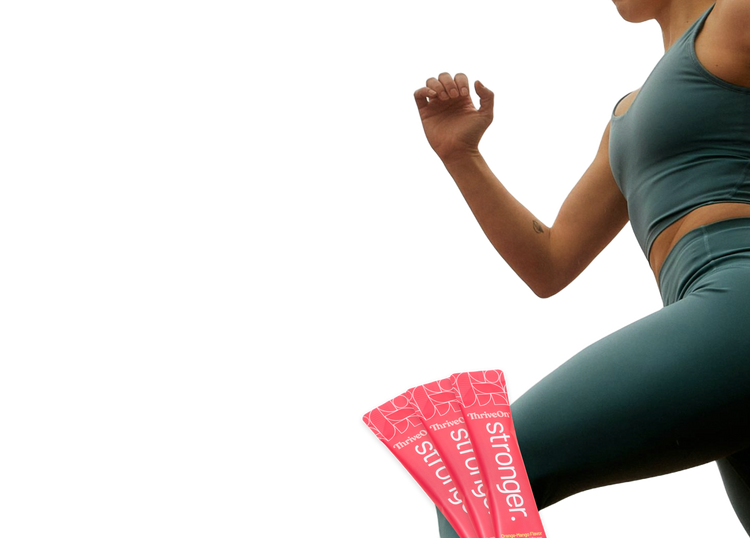
Stronger is a once-a-day powdered supplement for midlife women. Each sachet delivers clinically relevant doses of German Creavitalis® creatine (5g), marine tripeptide collagen (3g), and taurine (500mg), plus targeted levels of Rhodiola, vitamin C, hyaluronic acid, vitamin D3, and vitamin K2 to help maintain lean muscle and bone, nourish skin and joints, sustain steady energy, and support mental clarity.
Starting from: $49.00
Daily support for:
- Steady energy
- Mental clarity
- Radiant skin
- Lean muscle mass
- Supple joints
- Strong bones
✅ 60-Day Money-Back Guarantee**


What women are saying
Our community is the heart of ThriveOn
A place to connect, share wisdom, and feel supported through every shift.
Live Q&As with women’s health experts
Member discussions and shared experiences
Real strategies for navigating perimenopause and menopause
Early access to education and resources
A safe, judgment-free space to be yourself