


Perimenopause
Menopause Dry Skin: Why Your Moisturizer Isn't Failing You
Midlife dryness isn't only on the surface. Keep the moisturizer, and here's what the research says about the rest.

Midlife dryness isn't only on the surface. Keep the moisturizer, and here's what the research says about the rest.
At a Glance
- After menopause, skin collagen falls about 1 to 2% a year.
- More than 1 in 3 women past menopause had dry skin on a doctor's skin exam.
- Moisturizer and sunscreen still matter. They work on the surface.
- From the inside, the clearest evidence is for collagen (mostly hydration) and vitamin C, which your body needs to make collagen.
Maybe it started with a new moisturizer that didn't seem to do much. Then a richer one. Then the one your friend swears by. If your skin has felt drier through perimenopause or since your last period, there's a reason. Menopause dry skin isn't only a surface problem, and part of it sits below the layer any cream can reach.
Dry skin after menopause is common
In a large US health survey, doctors examined the skin of women past menopause, and more than 1 in 3 had dry skin (Dunn et al., 1997). A survey published in 2026 asked 4,303 women aged 45 to 60 in perimenopause or menopause what had changed. Of the women surveyed, 56% said their skin was drier (Fabi et al., 2026; the survey was funded by the skincare company Galderma).
It isn't only about how skin looks. In the same survey, 57% said these changes brought anxiety or low mood, and 55% said they hit their confidence. If that sounds familiar, our piece on mood changes in perimenopause covers that side of it.
What causes menopause dry skin
Skin responds to estrogen. Estrogen acts on the cells that build the outer layer of skin, on the fibroblasts that make collagen, and on the oil glands (Thornton, 2013). When estrogen falls, skin tends to get thinner, with less collagen and less elasticity, and it gets drier.
That fall isn't spread evenly over the years before menopause. In a large US study that followed women through menopause, estrogen levels held fairly steady on average until about two years before the final period, dropped fastest around it, then settled about two years after (Randolph et al., 2011). That may be why perimenopause skin changes can seem to arrive all at once.
Collagen. After menopause, skin collagen falls about 1 to 2% a year (Brincat et al., 1987). Thinner skin with less collagen tends to go along with drier skin after menopause (Thornton, 2013). In one small study of women not on hormones, skin collagen was lower in women further past menopause, and it tracked the years since menopause rather than age (Brincat et al., 1985).
Oil. Skin tends to make less of its own oil after menopause. In women, oil output usually falls gradually after menopause and levels off by about age 70 (Pochi et al., 1979).
The barrier. The outer layer is held together by fats, including ceramides. One small study, funded by the skincare maker Walgreens Boots Alliance, found lower ceramide levels in women after menopause who weren't on hormone therapy (Mellody et al., 2022). Whether the barrier itself loses more water after menopause is less settled: a 2025 study of 81 women found no clear difference in water loss between women after menopause and younger women (Nikoletic et al., 2025). The collagen change is the best-measured part of the story.
Not sure where you are in the transition? Our perimenopause symptom checklist walks through it, and our full guide to perimenopause covers the rest of the picture.
What your moisturizer can and can't do
Moisturizer works on the outermost layer of skin. It softens it, seals in water and makes skin feel better, so keep it. What it can't reach is the collagen underneath, which is where many menopause skin changes happen. That's why buying a new one every few months rarely feels like the answer.

What helps from the outside
- Keep the moisturizer. Dermatologists suggest a fragrance-free cream or ointment rather than a lotion, put on right after a shower or bath while skin is still damp (American Academy of Dermatology).
- Go easy in the shower. Dermatologists suggest keeping baths and showers to five to ten minutes in warm water, using a gentle cleanser only where you need it, and patting skin dry instead of rubbing (American Academy of Dermatology).
- Add moisture to the air. A humidifier in the bedroom while you sleep puts moisture back into dry indoor air (American Academy of Dermatology).
- Wear sunscreen every day. In a 4.5-year trial of 903 adults under 55 in Australia, the group who used broad-spectrum sunscreen every day showed no detectable increase in skin aging. Their skin aged 24% less over the trial than the group who used sunscreen when they chose (Hughes et al., 2013).
- Know when to see a dermatologist. If your skin stays dry, itchy or cracked after you've tried these steps, a dermatologist can check what's going on (American Academy of Dermatology).
What helps from the inside
Vitamin C. Your body needs vitamin C to make its own collagen (NIH Office of Dietary Supplements). In a study of 4,025 US women aged 40 to 74, those who ate more vitamin C were less likely to have dry skin (Cosgrove et al., 2007). That study looked at food, and it shows a link, not a cause.
Collagen. A 2026 review of 35 randomized trials with 2,534 people found that oral collagen improved measured skin hydration, elasticity and the skin's barrier against water loss. The results seemed to depend more on how long people took it than on how much, and the elasticity and barrier changes took at least 12 weeks (Batool et al., 2026).
A 2025 analysis of 23 trials also found improvements overall, but the company-funded trials drove that result. The trials without company funding, and the higher-quality trials, found no significant effect (Myung and Park, 2025). We've laid out what the trials found for collagen and skin hydration in more detail.
- Water. Drinking more water may slightly raise moisture in the skin's outer layer, mostly in people who drank little to begin with. The evidence is thin, and it comes mostly from younger and middle-aged adults (Akdeniz et al., 2018), so drink to thirst rather than expecting water alone to fix dry skin.
- Sleep. In a study of 60 women, those who slept poorly lost more water through their skin, and good sleepers' skin barrier recovered 30% better after a mild tape-strip test (Oyetakin-White et al., 2015). It's a small study and shows a link, but sleep is worth protecting anyway.
- Protein. No good trial has tested whether eating more protein eases dry skin. Collagen is itself a protein, though, so getting enough protein is part of the everyday basics.
What about hormone therapy?
If you're weighing hormone therapy for menopause symptoms, your doctor can talk it through with you. For skin, the evidence is mixed. A review of 15 studies found it raised skin elasticity, thickness and collagen, but made no clear difference to dryness (Pivazyan et al., 2023). In a 4-year placebo-controlled trial of low-dose hormone therapy in women in early menopause, women taking it ended up with about the same wrinkle and skin-firmness scores as women on placebo (Owen et al., 2016).
And it's not only skin deep
The same building blocks matter beyond your skin. Collagen is a building block of cartilage and the tissue around your joints, and hyaluronic acid is part of the fluid that cushions them. If your joints have been changing too, here's why joints ache in menopause.
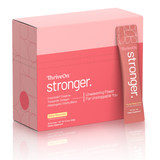
Where Stronger fits
Stronger supports skin hydration and your body's own collagen production,* with 3g of marine tripeptide collagen and 340mg of vitamin C in every sachet, plus hyaluronic acid, which has been studied for skin moisture.** In a 28-day study at 5g a day, the marine tripeptide collagen we use raised skin hydration 12.9% compared with placebo.*** Here's why collagen peptide size matters.
Stronger mixes into water or any drink of choice, once a day.
FAQ
Why is my skin so dry after menopause?
Falling estrogen affects the collagen, oil glands and outer layer of skin. After menopause, skin collagen falls about 1 to 2% a year, and skin tends to make less of its own oil.
Is dry skin a sign of perimenopause?
It can be. On average, estrogen starts falling about two years before the final period, so skin changes often show up in perimenopause, along with other symptoms. A doctor can help you sort out what's going on.
Why is my skin itchy during menopause?
Dry skin can flake, itch and crack, so the same steps that ease dryness often ease the itch. If it doesn't settle, see a dermatologist (American Academy of Dermatology).
Does drinking more water help menopause dry skin?
Possibly a little, mostly for people who drank little to begin with. The evidence is thin, and it's unclear whether it holds for older adults, so water works best alongside moisturizer, sunscreen and the other everyday basics.
Can collagen help dry skin after menopause?
Trials of oral collagen found improved skin hydration, and gains in elasticity and the skin barrier after at least 12 weeks. Trials without company funding found no clear effect, so it's a support, not a fix.
Does hormone therapy help skin?
For skin, the evidence is mixed. A review of 15 studies found it raised skin elasticity, thickness and collagen, but made no clear difference to dryness, and a 4-year placebo-controlled trial found no difference in wrinkles or skin firmness. Your doctor can talk through whether it fits you.
What kind of moisturizer is best for menopause skin?
Dermatologists suggest a fragrance-free cream or ointment, applied while skin is still damp, and skipping products that contain alcohol or fragrance (American Academy of Dermatology). A dermatologist can recommend one for your skin.
*These statements have not been evaluated by the Food and Drug Administration. This product is not intended to diagnose, treat, cure, or prevent any disease.
**Studied at 60 and 120mg a day, with clearer results at 120mg (Doleckova et al., 2025); Stronger provides 55mg.
***Hsu et al., 2025, a study sponsored by TCI, the company that makes this collagen: studied at 5g a day for 28 days; Stronger provides 3g.
References
- Brincat M, et al. A study of the decrease of skin collagen content, skin thickness, and bone mass in the postmenopausal woman. Obstet Gynecol. 1987;70(6):840-845. PMID 3120067.
- Brincat M, et al. Long-term effects of the menopause and sex hormones on skin thickness. Br J Obstet Gynaecol. 1985;92(3):256-259. PMID 3978054.
- Dunn LB, et al. Does estrogen prevent skin aging? Results from the First National Health and Nutrition Examination Survey (NHANES I). Arch Dermatol. 1997;133(3):339-342. PMID 9080894.
- Fabi SG, et al. A global survey of skin concerns and treatment interests in perimenopausal and menopausal patients. Dermatol Surg. 2026 (online ahead of print). PMID 42910886. Funded by Galderma.
- Thornton MJ. Estrogens and aging skin. Dermatoendocrinol. 2013;5(2):264-270. PMID 24194966.
- Randolph JF, et al. Change in follicle-stimulating hormone and estradiol across the menopausal transition: effect of age at the final menstrual period. J Clin Endocrinol Metab. 2011;96(3):746-754. PMID 21159842.
- Pochi PE, Strauss JS, Downing DT. Age-related changes in sebaceous gland activity. J Invest Dermatol. 1979;73(1):108-111. PMID 448169.
- Mellody KT, et al. Influence of menopause and hormone replacement therapy on epidermal ageing and skin biomechanical function. J Eur Acad Dermatol Venereol. 2022;36(7):e576-e580. PMID 35279892. Funded by Walgreens Boots Alliance.
- Nikoletic DC, et al. Menopause, menstrual cycle, and skin barrier function. Skin Res Technol. 2025;31(7):e70203. PMID 40583043.
- Hughes MC, et al. Sunscreen and prevention of skin aging: a randomized trial. Ann Intern Med. 2013;158(11):781-790. PMID 23732711.
- NIH Office of Dietary Supplements. Vitamin C: fact sheet for health professionals. https://ods.od.nih.gov/factsheets/VitaminC-HealthProfessional/
- Cosgrove MC, et al. Dietary nutrient intakes and skin-aging appearance among middle-aged American women. Am J Clin Nutr. 2007;86(4):1225-1231. PMID 17921406.
- Batool A, et al. Oral collagen peptides and skin rejuvenation: a systematic review and an updated meta-analysis of randomized controlled trials. J Cosmet Dermatol. 2026;25(7):e71041. DOI 10.1111/jocd.71041.
- Myung SK, Park Y. Effects of collagen supplements on skin aging: a systematic review and meta-analysis of randomized controlled trials. Am J Med. 2025;138(9):1264-1277. PMID 40324552.
- Akdeniz M, et al. Does dietary fluid intake affect skin hydration in healthy humans? A systematic literature review. Skin Res Technol. 2018;24(3):459-465. PMID 29392767.
- Oyetakin-White P, et al. Does poor sleep quality affect skin ageing? Clin Exp Dermatol. 2015;40(1):17-22. PMID 25266053.
- Pivazyan L, et al. Skin rejuvenation in women using menopausal hormone therapy: a systematic review and meta-analysis. J Menopausal Med. 2023;29(3):97-111. PMID 38230593.
- Owen CM, et al. Effects of hormones on skin wrinkles and rigidity vary by race/ethnicity: four-year follow-up from the ancillary skin study of the Kronos Early Estrogen Prevention Study. Fertil Steril. 2016;106(5):1170-1175.e3. PMID 27393520.
- Hsu et al. Marine tripeptide collagen (5g a day, 28 days). 2025. ClinicalTrials.gov NCT06194487. Sponsored by TCI Co., Ltd., the ingredient maker.
- Doleckova I, et al. Oral sodium hyaluronate improves skin hydration, barrier function and signs of aging: a randomized, double-blind, placebo-controlled trial in 150 healthy adults. Sci Rep. 2025;16:2941. PMID 41422283. Authors employed by Contipro, a hyaluronic acid maker.
- American Academy of Dermatology. Dermatologists' top tips for relieving dry skin. aad.org.
Creatine and collagen, already together.
Stronger puts 5 grams of Creavitalis® creatine and 3 grams of marine tripeptide collagen in one daily sachet. Prefer to start with creatine alone? ThriveOn Creatine is the same creatine and nothing else. Subscriptions ship free.


