



Perimenopause
Cortisol and Perimenopause: Why Your Stress History Belongs in the Conversation
Estrogen gets the attention. But research on stress, from childhood and from right now, says your stress system belongs in the menopause conversation too.

Estrogen gets the attention. But research on stress, from childhood and from right now, says your stress system belongs in the menopause conversation too.
We always go to estrogen, progesterone and testosterone. We never really talk about cortisol.
Yet when researchers look at what shapes a woman's perimenopause, stress keeps showing up. In a Mayo Clinic study of 1,670 women, those with four or more adverse childhood experiences had 4.5 times the odds of severe menopause symptoms, even after accounting for depression and anxiety. Recent stress counts too, especially for mood.
So here's what cortisol does, what the research actually says about it in perimenopause, and what helps.
What to Know Before You Start
- Cortisol is your main stress hormone, and you need it: it peaks in the morning, right before you wake up, and drops in the evening.
- Research on cortisol across perimenopause is mixed, so be wary of anyone selling a "cortisol fix."
- Your history counts: in a Mayo Clinic study of 1,670 women, four or more adverse childhood experiences were linked to 4.5 times the odds of severe menopause symptoms.
- Stress now counts too: a very stressful life event was linked to more than twice the risk of a first major depression in midlife women.
- What helps: protecting your sleep, CBT or clinical hypnosis for hot flashes, support for the stress itself, and telling your doctor the whole story.
What does cortisol do?
Cortisol is made by your adrenal glands, two small glands that sit on top of your kidneys. It's called the stress hormone, but it does far more than react to stress. It helps regulate how your body uses sugar for energy, lowers inflammation, helps regulate blood pressure and helps control your sleep-wake cycle.1
It also follows a daily rhythm. Levels peak in the morning, right before you wake up, and are lower in the evening as you head to sleep. That rhythm is part of how your body wakes up.1
Your brain controls the release. The hypothalamus signals the pituitary gland, which signals the adrenals, and researchers call this chain the HPA axis. When this post says "your stress system," that's what it means.
What happens to cortisol in perimenopause?
The research is mixed. Some earlier studies found cortisol rising in perimenopause, but in a study that followed 127 women for 13 months, being in early or late perimenopause didn't predict their cortisol.3 A different study looked at hot flashes: in a snapshot of 306 women aged 40 to 62 with frequent hot flashes, most of them past menopause, those with the most hot flashes had the lowest cortisol half an hour after waking, a pattern the researchers compared to chronic sleep disturbance.2
One proposed model is that the hormone swings of perimenopause may make the stress system more sensitive in some women, so the same stress hits harder and depression becomes more likely.4
| What we know | What we don't know yet |
|---|---|
| Cortisol follows a daily rhythm: highest in the morning, lower in the evening. | Whether cortisol reliably rises or falls across perimenopause. The research is mixed. |
| Lost sleep raises it: in one lab study in young men, evening cortisol rose 37% after a short night and 45% after no sleep. | Whether cortisol is what links early stress to later symptoms. Researchers call that pathway speculative. |
| A hard childhood and stressful life events are linked to a harder transition. | Why the same stress hits some women harder than others. One model has been proposed. |
Your history is part of your health
One large study on this comes from the Mayo Clinic. Researchers asked 1,670 women aged 40 to 65 about adverse childhood experiences, or ACEs: abuse, neglect and household hardship before age 18. More than half, 58.5%, reported at least one, and 17.2% reported four or more.
Women with four or more ACEs had 4.5 times the odds of severe menopause symptoms, even after the researchers accounted for depression, anxiety, hormone therapy and more.5 The pattern held across physical, emotional and urogenital symptoms.
Other studies point the same way. In 332 women followed for eight years, childhood abuse or neglect was linked to about 1.7 times the odds of reporting hot flashes, and about the same for night sweats.6 And in 243 women followed through the transition, two or more ACEs were linked to 2.6 times the odds of a first major depression during it.7
These are links, not proof of cause. The Mayo team's conclusion was practical: women with bothersome symptoms should be asked about childhood adversity, and offered support for it.
If this brings up something heavy, a therapist trained in trauma can help you carry it.
Where cortisol comes in
So how could something from decades ago show up in perimenopause? Researchers think early abuse or neglect can change the stress system for the long term, and that those changes may affect the system that runs your reproductive hormones.6
The authors call this pathway speculative, since their study measured symptoms, not cortisol.
Stress now counts too
It isn't only the past. In 266 midlife women with no history of major depression, followed for seven years, a very stressful life event was linked to more than twice the risk of a first major depression.8 Once the researchers weighed everything together, a very stressful life event and a past anxiety disorder predicted it, and frequent hot flashes no longer did.
The transition itself matters as well. Among 460 women with no history of major depression, those who entered perimenopause were twice as likely to develop significant depressive symptoms as women who hadn't yet, even after accounting for age and stressful life events.9
There's a hopeful side to this. In a 2024 meta-analysis pooling 9,141 women, the higher risk of depression showed up in perimenopause, not after menopause.10
If your mood has shifted, our post on perimenopause anxiety, irritability and mood changes goes deeper.
What actually helps
You can't switch cortisol off, and you wouldn't want to. What you can change is the load on your stress system and the support around it.
- Tell your doctor the whole story. That means the stress you're under, not only the symptoms, and your history if you're ready to share it. The Mayo researchers recommend asking women with bothersome symptoms about childhood adversity.5 If you're not sure where you are in the transition, start with how to know if you're in perimenopause.
- Ask about CBT or clinical hypnosis for hot flashes. The Menopause Society recommends both, at its highest level of evidence.11 CBT makes hot flashes less bothersome, and hypnosis reduces how often and how strongly they hit. Your doctor can also walk you through hormonal and nonhormonal medical options.
- Protect your sleep. In a lab study of young men, a night of four hours' sleep raised cortisol the next evening by 37%, and a night with no sleep raised it by 45%.12 If night sweats are breaking your nights, we cover what helps in night sweats and insomnia in perimenopause.
- Try a meditation program. A 2021 review of randomized trials found meditation programs lowered cortisol in people at higher risk, from illness or hard life circumstances.13
- Talk it through. If the past still weighs on you, a therapist trained in trauma is a good place to take it.
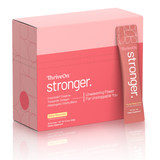
Every Stronger sachet has rhodiola, an adaptogen that supports a healthy stress response,* alongside 5 grams of German-made Creavitalis® creatine and marine tripeptide collagen. One sachet a day, in water or any drink of choice.
What cortisol isn't: "adrenal fatigue"
You may have seen "adrenal fatigue" blamed for midlife exhaustion: a label for tiredness and other symptoms said to come from long-term stress. The Endocrine Society, the professional society for hormone specialists, puts it plainly: "No scientific proof exists to support adrenal fatigue as a true medical condition."14
If you're running on empty, that's worth raising with your doctor, who can look for causes that can be tested and treated.
Bring the whole story
Estrogen gets most of the attention in this season, and it deserves a lot of it. But the research on stress keeps landing in the same place: what you carry, from years ago or from this year, is part of how perimenopause feels. It belongs in the conversation with your doctor, right next to the hot flashes and the 3 AM wake-ups.
Then build support around the load you actually carry: sleep you protect, help for the hot flashes, someone to talk to, and a daily foundation you can keep. That last one is why every Stronger sachet has rhodiola, to support a healthy stress response.*
Stronger is one daily sachet with 5 grams of German-made Creavitalis® creatine, marine tripeptide collagen, rhodiola and supporting nutrients. Your first order comes with a 60-day money-back guarantee.
Keep reading
Perimenopause Night Sweats and Insomnia: Why Sleep Breaks in Midlife
Perimenopause Anxiety, Irritability and Mood Changes Are Real
Common questions
Does perimenopause raise cortisol?
The research is mixed. In one study that followed 127 women for 13 months, being in early or late perimenopause didn't predict their cortisol. Short sleep and stress do raise it.
Can childhood trauma affect menopause symptoms?
Research links the two. In a Mayo Clinic study of 1,670 women, four or more adverse childhood experiences were linked to 4.5 times the odds of severe menopause symptoms, and an eight-year study linked childhood abuse or neglect to higher odds of reporting hot flashes and night sweats. These are associations, not proof of cause, and the Mayo researchers recommend that doctors ask about it.
Can stress make hot flashes worse?
Stress and hot flashes are linked in the research: in one eight-year study, women who experienced abuse or neglect in childhood had about 1.7 times the odds of reporting hot flashes. For the hot flashes themselves, The Menopause Society recommends CBT and clinical hypnosis.
How do I lower cortisol naturally?
You can't switch it off, and you wouldn't want to, because you need it every morning. The clearest link is sleep: one lab study in young men found evening cortisol 45% higher after a sleepless night. Beyond that, what helps is lowering the load on your stress system: getting help with hot flashes and stress, and telling your doctor what you're carrying.
Is adrenal fatigue real?
Not as a medical diagnosis. The Endocrine Society says no scientific proof exists to support adrenal fatigue as a true medical condition. Ongoing exhaustion is still worth raising with your doctor, who can look for causes that can be tested and treated.
Is this just stress?
No. Perimenopause itself is linked to mood changes: in one study of women with no history of major depression, those who entered perimenopause were twice as likely to develop significant depressive symptoms, even after accounting for stressful life events. Stress is one more piece of it.
References
- Cleveland Clinic. Cortisol. Medically reviewed 2025-02-17. https://my.clevelandclinic.org/health/articles/22187-cortisol
- Reed SD, Newton KM, Larson JC, et al. Daily salivary cortisol patterns in midlife women with hot flashes. Clin Endocrinol (Oxf). 2016;84(5):672-679. https://doi.org/10.1111/cen.12995
- Grub J, Süss H, Willi J, Ehlert U. Steroid hormone secretion over the course of the perimenopause: findings from the Swiss Perimenopause Study. Front Glob Womens Health. 2021;2:774308. https://doi.org/10.3389/fgwh.2021.774308
- Gordon JL, Girdler SS, Meltzer-Brody SE, et al. Ovarian hormone fluctuation, neurosteroids, and HPA axis dysregulation in perimenopausal depression: a novel heuristic model. Am J Psychiatry. 2015;172(3):227-236. https://doi.org/10.1176/appi.ajp.2014.14070918
- Kapoor E, Okuno M, Miller VM, et al. Association of adverse childhood experiences with menopausal symptoms: results from the Data Registry on Experiences of Aging, Menopause and Sexuality (DREAMS). Maturitas. 2021;143:209-215. https://doi.org/10.1016/j.maturitas.2020.10.006
- Thurston RC, Bromberger J, Chang Y, et al. Childhood abuse or neglect is associated with increased vasomotor symptom reporting among midlife women. Menopause. 2008;15(1):16-22. https://pubmed.ncbi.nlm.nih.gov/18257140/
- Epperson CN, Sammel MD, Bale TL, et al. Adverse childhood experiences and risk for first-episode major depression during the menopause transition. J Clin Psychiatry. 2017;78(3):e298-e307. https://doi.org/10.4088/JCP.16m10662
- Bromberger JT, Kravitz HM, Matthews K, et al. Predictors of first lifetime episodes of major depression in midlife women. Psychol Med. 2009;39(1):55-64. https://doi.org/10.1017/S0033291708003218
- Cohen LS, Soares CN, Vitonis AF, et al. Risk for new onset of depression during the menopausal transition: the Harvard Study of Moods and Cycles. Arch Gen Psychiatry. 2006;63(4):385-390. https://doi.org/10.1001/archpsyc.63.4.385
- Badawy Y, Spector A, Li Z, Desai R. The risk of depression in the menopausal stages: a systematic review and meta-analysis. J Affect Disord. 2024;357:126-133. https://doi.org/10.1016/j.jad.2024.04.041
- The North American Menopause Society. The 2023 nonhormone therapy position statement of The North American Menopause Society. Menopause. 2023;30(6):573-590. https://doi.org/10.1097/GME.0000000000002200
- Leproult R, Copinschi G, Buxton O, Van Cauter E. Sleep loss results in an elevation of cortisol levels the next evening. Sleep. 1997;20(10):865-870. https://pubmed.ncbi.nlm.nih.gov/9415946/
- Koncz A, Demetrovics Z, Takacs ZK. Meditation interventions efficiently reduce cortisol levels of at-risk samples: a meta-analysis. Health Psychol Rev. 2021;15(1):56-84. https://doi.org/10.1080/17437199.2020.1760727
- Endocrine Society. Adrenal fatigue. 2022. https://www.endocrine.org/patient-engagement/endocrine-library/adrenal-fatigue
*These statements have not been evaluated by the Food and Drug Administration. This product is not intended to diagnose, treat, cure, or prevent any disease.
This article is for general information and is not medical advice. If stress, mood or symptoms are changing your daily life, speak with a qualified healthcare professional.
Creatine and collagen, already together.
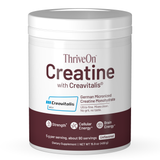
Stronger puts 5 grams of Creavitalis® creatine and 3 grams of marine tripeptide collagen in one daily sachet. Prefer to start with creatine alone? ThriveOn Creatine is the same creatine and nothing else. Subscriptions ship free.


