

Brain health
Best Exercise for Bone Density in Midlife: Walking, Weights or Jumping?
Walking is good for you. Your bones barely notice it. Here's the best exercise for bone density according to the trials in women, and why the same rule turns out to apply to your brain.

Walking is good for you. Your bones barely notice it. Here's the best exercise for bone density according to the trials in women, and why the same rule turns out to apply to your brain.
At a glance
- Bone tunes out the loads it's used to, so a daily walk barely registers.
- Bone builds most from unfamiliar forces: a new direction, a new speed, a heavier load.
- In women with low bone mass after menopause, mixing heavier lifting with impact work raised spine bone density 2.9% in 8 months. The comparison group lost 1.2%.
- After menopause, jumping on its own wasn't enough in the trials. The mix was.
- Your brain likes variety too: adults who added more of it to their days scored higher on thinking tests.
Does walking help bone density?
Keep walking. It supports your heart, your mood and your sleep, and it keeps you moving through a full day.
For your bones, though, a daily walk is a familiar load, and bone is built to tune out familiar loads. As the bone researcher Charles Turner put it, bone cells "accommodate to a customary mechanical loading environment, making them less responsive to routine loading signals." The walk you take every day stops registering as news.
The trials point the same way. In a review of exercise trials in postmenopausal women, the programs that improved bone density mixed walking or jogging with something more demanding, like stair climbing, or combined impact work with resistance training.
What your bones actually respond to
Bone is living tissue, constantly being broken down and rebuilt. What tells it to build is strain, and not all strain counts equally.
Decades of research by the bone biologist Lance Lanyon found that "unusual strain distributions, high strains, and high strain rates seem to be particularly osteogenic," meaning bone-building. In plain terms, bone responds most to:
- A new direction: a sidestep, a turn, a change of pace.
- A new speed: a quick push-off, a short burst.
- A heavier load: more weight than you usually carry.

And it doesn't take long. Lanyon found that bone's response saturates after only a few loading cycles, so a handful of the right movements does more than an hour of the same one. His advice for bone-building sessions was to include "as many novel strain distributions as possible." Variety is the point.
Weight training for bone density
The clearest trial in women around menopause is LIFTMOR, from Griffith University in Australia.
- 101 postmenopausal women with low bone mass took part, average age 65.
- One group did 30 minutes of coached, high-intensity strength and impact training twice a week for 8 months.
- The comparison group did a gentle home program.
- Spine bone density rose 2.9% in the training group and fell 1.2% in the comparison group. At the hip, it held steady (+0.3%) while the comparison group lost 1.9%.
- There was one minor adverse event, a back spasm. A follow-up found the training did not cause spine fractures.

A 2021 analysis of 53 trials in healthy postmenopausal women pointed the same way. Higher-intensity programs produced the biggest gains at the spine, and the authors concluded that "resistance training, potentially in combination with impact training, appears to be the most effective osteogenic stimulus."
The common thread is load your bones aren't used to: heavier than usual, and often combined with impact.
Is jumping good for bone density?
Jumping is a classic bone-builder, and before menopause it works on its own. In a trial of premenopausal women, 50 small jumps a day, six days a week, raised hip bone density 2.8% in five months.
After menopause, the picture changes. The same researchers ran the same jumping program in postmenopausal women, and it made no difference to bone density after 12 or 18 months, whether or not the women were taking HRT. A review of trials in postmenopausal women found the same: "high-impact only and odd-impact only protocols were ineffective." The programs that worked combined impact with strength training or other loading.

So after menopause, jumping is one ingredient, not the whole recipe. It earns its place as part of a mix.
Osteoporosis exercises: how to train safely with low bone mass
If you already know your bone density is low, exercise still matters, and the guidance is to adapt it rather than avoid it.
- Australia's exercise and sports science position statement on osteoporosis recommends impact activities and high-intensity progressive resistance training for bone. It notes that impact "may require modification" with osteoarthritis or frailty, and that loaded spine flexion (bending forward under load) is not recommended.
- The international Too Fit To Fracture recommendations say that after a spine fracture, moderate intensity is preferred over vigorous, with spine-sparing technique.
- In the LIFTMOR trial, women with low bone mass trained safely under supervision.
Work with your doctor or a qualified trainer to find the right starting point. The long view is encouraging: in a 16-year German study of women in early menopause, those who kept exercising had about half as many low-trauma fractures as those who didn't. The groups weren't randomly assigned, so it shows a link rather than proof, but it's a long time to see a difference.
Your brain likes variety too
The same rule turns out to apply above the neck.

In a study from Penn State, researchers followed 732 adults with an average age of 56 for ten years. The people who added more variety to their daily lives, across work, leisure, physical activity, volunteering and time with others, scored higher on thinking tests. The paper's title says it simply: "Change Is Good for the Brain." It shows a link, not proof of cause, and later studies tied daily variety to a larger hippocampus, the brain's memory center.
New and a little challenging seems to matter most. In the Synapse Project, adults aged 60 to 90 spent three months learning digital photography or quilting, and their memory improved. The authors concluded that "sustained engagement in cognitively demanding, novel activities enhances memory function." A year later, the gains held.
And yes, mahjong has its own research. In a small trial, playing mahjong three times a week for 12 weeks improved executive function, the skills you use to plan, focus and switch between tasks. The comparison group, who kept to their usual routine, saw no change.
One caution: brain-training apps mostly make you better at the app. Reviews find little evidence they carry over to everyday thinking. Real life, mixed up, looks like the better bet. More on midlife thinking in our post on menopause brain fog.
Five ways to surprise your bones (and your brain)

“Somewhere along the way, my days started running on autopilot. Turns out a few surprises are good for my bones and my brain.”
Victoria O'Hare, ThriveOn co-founder
You don't need a new routine. Just one surprise in the one you have. Pick one:
- Lift something heavier. If you already lift, add weight gradually. If you don't, a coached class is a good place to start.
- Add a hill, a jump or a new direction. Change your walking route, add a few hops if your joints say yes, or try a sport with quick turns.
- Take a new class or try a new sport. Pickleball, dance, tennis, anything with the variety bone responds to.
- Change the order of your week. New routes, new times, new people.
- Learn the thing you've always been curious about. A language, an instrument, a game. Mahjong counts.
For more on why strength matters in this season, see why perimenopause weight gain starts with muscle loss and our guide to joint aches in perimenopause.
FAQ
How often should I lift for bone density?
In the LIFTMOR trial, two 30-minute sessions a week were enough to raise spine bone density in 8 months. Consistency over months matters more than any single session.
Is it too late to build bone after menopause?
No. LIFTMOR's participants were on average 65 and already had low bone mass, and their spine bone density still rose. The mix of strength and impact work is what made the difference.
Can I jump if I have osteoporosis?
Ask your doctor or a qualified trainer first. Impact can often be modified rather than avoided, but after a spine fracture the guidance is to favor moderate intensity and protect the spine.
Does yoga help bone density?
Yoga is great for balance, which matters for staying steady on your feet, but on its own it hasn't been shown to change bone density in randomized trials. The best results come when mind-body work like yoga or tai chi is paired with strength training. If your bone density is low, ask your doctor which poses suit you, because deep forward folds and twists have been linked to spinal fractures in people with fragile bones.
Does creatine help bone density?
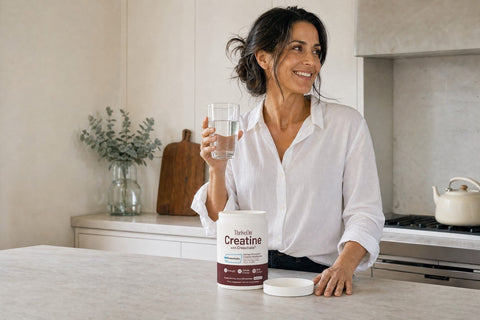
Creatine doesn't appear to raise bone density on its own. Pooled trials in postmenopausal women found no change. Research suggests creatine may help protect bone when combined with resistance training. In a 12-month study, postmenopausal women who lifted and took 7 to 9g a day lost less bone at the hip than women who only lifted. A larger 2-year study found no difference in bone density, but the creatine group's hip bone structure held steady while the placebo group's slipped, and they walked faster. More in our review of creatine after menopause.
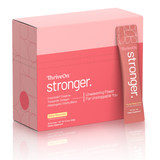
Stronger is the steady daily part: 5g of Creavitalis® creatine and 3g of marine tripeptide collagen in one sachet, to support muscle strength and brain energy.* Mix it into water or any drink of choice.
Try it with a 60-day money-back guarantee.
*These statements have not been evaluated by the Food and Drug Administration. This product is not intended to diagnose, treat, cure, or prevent any disease.
For education only. Always consult your doctor for personalized advice.
References
- Turner CH. Three rules for bone adaptation to mechanical stimuli. Bone. 1998;23(5):399-407. PMID 9823445.
- Lanyon LE. Using functional loading to influence bone mass and architecture: objectives, mechanisms, and relationship with estrogen of the mechanically adaptive process in bone. Bone. 1996;18(1 Suppl):37S-43S. PMID 8717546.
- Watson SL, et al. High-intensity resistance and impact training improves bone mineral density and physical function in postmenopausal women with osteopenia and osteoporosis: the LIFTMOR randomized controlled trial. J Bone Miner Res. 2018;33(2):211-220. PMID 28975661.
- Kistler-Fischbacher M, Weeks BK, Beck BR. The effect of exercise intensity on bone in postmenopausal women (part 2): a meta-analysis. Bone. 2021;143:115697. PMID 33357834.
- Bassey EJ, et al. Pre- and postmenopausal women have different bone mineral density responses to the same high-impact exercise. J Bone Miner Res. 1998;13(12):1805-13. PMID 9844097.
- Martyn-St James M, Carroll S. A meta-analysis of impact exercise on postmenopausal bone loss: the case for mixed loading exercise programmes. Br J Sports Med. 2009;43(12):898-908. PMID 18981037.
- Beck BR, et al. Exercise and Sports Science Australia (ESSA) position statement on exercise prescription for the prevention and management of osteoporosis. J Sci Med Sport. 2017;20(5):438-445. PMID 27840033.
- Giangregorio LM, et al. Too Fit To Fracture: outcomes of a Delphi consensus process on physical activity and exercise recommendations for adults with osteoporosis with or without vertebral fractures. Osteoporos Int. 2015;26(3):891-910. PMID 25510579.
- Kemmler W, et al. Exercise and fractures in postmenopausal women. Final results of the controlled Erlangen Fitness and Osteoporosis Prevention Study (EFOPS). Osteoporos Int. 2015;26(10):2491-9. PMID 25963237.
- Lee S, Charles ST, Almeida DM. Change is good for the brain: activity diversity and cognitive functioning across adulthood. J Gerontol B Psychol Sci Soc Sci. 2021;76(6):1036-48. PMID 32025733.
- Park DC, et al. The impact of sustained engagement on cognitive function in older adults: the Synapse Project. Psychol Sci. 2014;25(1):103-12. PMID 24214244.
- Simons DJ, et al. Do "brain-training" programs work? Psychol Sci Public Interest. 2016;17(3):103-186. PMID 27697851.
- Bajaj P, et al. Effect of yoga on balance, falls, and bone metabolism: a systematic review of randomized controlled trials in healthy individuals. Osteoporos Int. 2025;36(2):193-224. PMID 39607489.
- Sfeir JG, Drake MT, Sonawane VJ, Sinaki M. Vertebral compression fractures associated with yoga: a case series. Eur J Phys Rehabil Med. 2018;54(6):947-951. PMID 29687967.
- Chilibeck PD, Candow DG, et al. Effects of creatine and resistance training on bone health in postmenopausal women. Med Sci Sports Exerc. 2015;47(8):1587-95. PMID 25386713.
- Chilibeck PD, Candow DG, et al. A 2-yr randomized controlled trial on creatine supplementation during exercise for postmenopausal bone health. Med Sci Sports Exerc. 2023;55(10):1750-60. PMID 37144634.
- Forbes SC, Chilibeck PD, Candow DG. Creatine supplementation during resistance training does not lead to greater bone mineral density in older humans: a brief meta-analysis. Front Nutr. 2018;5:27. PMID 29740583.
- Zhang H, Peng Y, Li C, Lan H, Xing G, Chen Z, Zhang B. Playing mahjong for 12 weeks improved executive function in elderly people with mild cognitive impairment: a study of implications for TBI-induced cognitive deficits. Front Neurol. 2020;11:178. PMID 32292385.
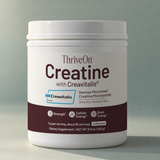
Creatine and collagen, already together.
Stronger puts 5 grams of Creavitalis® creatine and 3 grams of marine tripeptide collagen in one daily sachet. Prefer to start with creatine alone? ThriveOn Creatine is the same creatine and nothing else. Subscriptions ship free.


