


Creatine + collagen
Creatine and Collagen Together: What Each Does and How to Take Both
What each one does, how much of each to take, when to take them, what to mix them into, and who should check with a doctor first.

Can you take creatine and collagen together?
Yes. You can take collagen and creatine at the same time, even in the same glass, because they have no known interaction. They do different jobs: creatine supports strength and lean muscle with training, and collagen supports skin, joints and connective tissue. What matters is taking both every day. See how Stronger combines both
The Countertop Problem
Open your cabinet. Count the bottles.
The collagen powder from a podcast recommendation. The creatine you bought but aren't sure how to dose. The vitamin C gummies. The magnesium you keep forgetting. The adaptogen blend with ingredients you can't pronounce.
You're not being careless. You're being thorough.
These ingredients were chosen for jobs that depend on each other, and nobody designed them to be taken as a set. Your countertop isn't a wellness routine. It's a collection of good intentions that never learned to work together.
“We're busy, kids in school and sports, and it's hard enough to get a workout in, let alone remember the five daily supplements I'm taking. I'd have never stayed on my plan with summer travel, with all my separate supplements.”
The problem isn't what you're taking. It's that nothing is working together.
Creatine vs. Collagen: What Each Does
Here's what each one does on its own:
| Benefit | Creatine | Collagen |
|---|---|---|
| Primary Goal | Cellular energy and power output | Structural repair and tissue integrity |
| Target Tissue | Muscles, brain, fast-twitch fibers | Tendons, ligaments, skin, bone matrix |
| Speed of Results | Faster: muscle stores fill in about 3 to 4 weeks | Gradual: skin trials ran 8 to 12 weeks |
| How It Works | Regenerates ATP for immediate cellular fuel | Provides amino acids for tissue rebuilding |
| Midlife Priority | Tops up creatine stores | Counteracts 30% loss in first five years of menopause |
They're not interchangeable. They're complementary. One fuels the engine. The other maintains the frame.
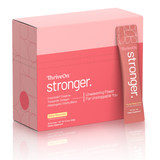
Stronger combines both in one daily sachet: 5g creatine + 3g marine collagen + 6 supporting ingredients.
How to Take Creatine and Collagen Together
We found no trial that has tested creatine and collagen as a pair, but each has years of research behind it on its own. That research answers the practical questions: when to take them, what to mix them into, how much of each, and who should check with a doctor first.
Can you take collagen and creatine at the same time?
Yes, or hours apart. Neither one needs a particular time of day, and neither needs to be timed around a workout. Creatine works by keeping your muscle stores full: a steady daily dose fills them in about three to four weeks (a loading week gets there sooner), and they stay full as long as you keep taking it. The collagen trials gave one dose a day. The easiest approach is to tie both to something you already do every day.
Can you mix creatine and collagen in the same drink?
Yes. Both stir into water or any drink of choice, your morning coffee included. Creatine is stable as a dry powder, but in liquid it slowly turns into creatinine, so mix each serving fresh and drink it, rather than mixing a bottle to keep for later. Taking them separately? A scoop of ThriveOn Creatine and your usual collagen can share the same glass.
How much creatine and collagen should you take?
The standard daily amount of creatine is 3 to 5g. For collagen, it depends on the type, from 1 to 15g a day.
| Ingredient | Typical daily amount in research | In one Stronger sachet |
|---|---|---|
| Creatine monohydrate | 3 to 5g, which fills muscle stores and keeps them full | 5g Creavitalis® creatine monohydrate |
| Tripeptide collagen | 1 to 5g in skin studies, including a 28-day trial of the collagen in Stronger at 5g | 3g marine tripeptide collagen (Maxicollagen) |
| Standard collagen peptides | 2.5 to 15g, depending on the goal | Stronger uses tripeptide collagen instead |
The Stronger column comes from its Supplement Facts panel, and no trial has tested Stronger itself. Its 3g of collagen sits inside that studied range for tripeptide collagen, in one daily sachet built to reward consistency.
Choosing products? Our guide to the best creatine and collagen for women covers what a good version of each looks like.
Is it safe to take creatine and collagen together?
For healthy adults, both have a strong safety record at these amounts. Reviews and a meta-analysis of creatine, including long-term studies, have found no harm to healthy kidneys at recommended doses, and collagen trials report few or no side effects. A few situations call for a word with your doctor first:
Kidney conditions or kidney stones. Ask before starting either one. If you have kidney blood work coming up, mention that you take creatine: it can raise creatinine, one of the markers that test reads.
Pregnancy or breastfeeding. Research on creatine in pregnancy is still early, so check with your doctor or midwife first.
Prescription medication or hormone replacement therapy (HRT). Check first, especially for blood pressure medication, diuretics or anything your doctor monitors with kidney labs.
Fish allergy. Marine collagen is made from fish, so check with your doctor before taking it.
The Engine and the Frame
Think of your body like a high-performance machine. Creatine is the engine: it powers the contractions, fuels the output, generates the force. Collagen is the frame: the structural network that absorbs that force, transfers it through tendons, and anchors it to bone.
Push an engine hard without maintaining the frame, and the whole system fails. The frame cracks under stress it can't absorb. The power has nowhere to go.
This is what happens when women supplement creatine alone. You generate more force, but if your connective tissue is degrading (which it is, after 35), that force doesn't transfer efficiently. Training adaptations suffer. Joints complain. The signal to build bone gets lost in weak tissue.
Conversely, supplement collagen alone, and you're rebuilding structure without the energy to stress it. Collagen needs mechanical loading to organize properly. No engine, no load. The frame never gets tested.
Together, they complete a loop neither completes alone.
The Full Sequence: How They Work Together
If you could only take two things in midlife, the research points here: creatine and collagen.
Not because they're trending. Because they work in sequence, each one making the other's job possible.
Here's the chain:
-
Creatine fuels muscle. Every cell runs on ATP. Creatine regenerates ATP faster than anything else in your body. More cellular energy means stronger muscle contractions, better training response, more force generated.
-
Muscle loads bone. When you lift something heavy, your muscle pulls on bone through tendons and fascia. That mechanical stress is the signal that tells osteoblasts to build new bone. Stronger muscle means a stronger signal.
-
Force travels through collagen. Tendons, fascia, the connective tissue web holding your structure together: it's all collagen-dependent. If that tissue is degraded, force transmission weakens. The signal to build bone gets lost.
-
Bone builds on collagen. Bone isn't just calcium. It's a composite: collagen provides the flexible matrix, minerals provide hardness. Without adequate collagen, bones don't just thin. They become brittle.
Break any link, the whole chain weakens. This is why creatine and collagen aren't just complementary. They're sequential.
Beyond Muscle: The Cognitive Case
Your brain is the most energy-hungry organ you have. It represents 2% of your body mass but consumes 20% of your energy. Every thought, every memory retrieval, every word you reach for runs on ATP.
Creatine is one of the fastest ways your body regenerates ATP. This matters more than you think during perimenopause, when fluctuating estrogen destabilizes cellular energy metabolism.
The fog that won't lift.
The word stuck on your tongue.
Walking into a room and forgetting why.
The mental fatigue that sleep doesn't fix.
For most women in perimenopause this is not a memory disorder. It tracks with the hormonal transition, and it is the kind of thing creatine has been studied for: cellular energy in a brain that is asking for more of it.
Studies in women show creatine supplementation improves working memory, processing speed under stress, and cognitive performance during sleep deprivation. Some clinical trials demonstrate benefits for mood. This isn't about gym performance. It's about showing up mentally for your life.
Research reviews report that women's creatine stores tend to run lower than men's, and a steady daily dose is how you keep them full.
Collagen plays a supporting role through a less obvious pathway: the gut-brain axis. The amino acids in collagen (particularly glycine) support gut lining integrity. A healthy gut lining means better nutrient absorption, less systemic inflammation, and clearer signaling between your gut and brain.
This isn't a gym stack. It's a cognitive support system.
Creatine powers the brain directly. Collagen supports the gut that talks to it. Together, they address the mental clarity concerns that bring most women to our door in the first place.
The Structural Decline You Can See
Collagen is the scaffolding: skin, joints, bones, tendons, the connective tissue holding everything together.
After 35, you lose 1-1.5% per year. After menopause begins, up to 30% can disappear in five years.
This is why skin thins and bruises easily. Why joints announce themselves on stairs. Why recovery takes longer. Why your body feels less resilient than it used to.
But here's what most people miss: collagen loss isn't selective. It's systemic. You're not just losing skin elasticity. You're losing the structural integrity of tendons, the flexibility of bone matrix, the connective tissue that transfers force from muscle to skeleton.
When collagen degrades, you don't just see it in the mirror. You feel it in every movement.
The Window You're In
If you're in perimenopause or past it, this is happening now:
But here's what matters: this is the window where intervention works.
Collagen synthesis can be stimulated. Creatine stores can be topped up. Bone responds to loading. Women who act during this transition maintain what others lose.
You're not too late. But you are in the window.
Ready to start? One sachet daily. German-made creatine + marine collagen + everything they need to work.
Why Your Current Approach May Not Be Working
Maybe you already lift. You eat protein. You prioritize sleep when you can.
But your body isn't responding like it used to. The effort doesn't seem to stick. You're doing the work and still losing ground.
Here's why: lifestyle creates the demand. Supplementation provides the supply.
Resistance training signals your body to build. But building requires raw materials: creatine for energy, collagen for structure, co-factors for the biochemical cascades that make it happen. Without adequate supply, the signal goes unanswered.
You're working hard. The right supplementation makes the work count.
Why Form Matters as Much as Function
You might already take creatine. You might already take collagen. If results have been underwhelming, the problem may not be the ingredients. It may be the form.
The creatine difference.
Most creatine on the market is commodity-grade: mass-produced with variable purity, inconsistent particle size, and limited quality control. This matters more than you'd think. Here is how to tell if creatine is good quality.
Impurities and large particle size are often behind the bloating and digestive issues that give creatine a bad reputation. Women who tried creatine and quit because of water retention or stomach discomfort likely experienced a quality problem, not a creatine problem.
Finely micronized creatine monohydrate from a facility that publishes its impurity testing dissolves cleanly. Less grit, and for most women at 5 g a day, none of the bloating that gets blamed on creatine. Same molecule, different experience.
The 5g daily dose matters too. The research supporting cognitive and strength benefits in women uses this dose consistently.
The collagen difference.
Standard hydrolyzed collagen has a molecular weight of 3,000-10,000 Daltons. Smaller peptides are preferentially absorbed. Clinical studies show low-molecular-weight peptides reach circulation intact at significantly higher rates.
Marine tripeptide collagen is hydrolyzed into peptides of 200-500 Daltons. Small peptides in this range have been measured in human blood after a dose, and the low-molecular-weight form has shown skin results at 1 g a day where standard hydrolysates typically use 5 to 10 g.
If your collagen doesn't specify "tripeptide" or indicate low molecular weight, you may be absorbing far less than you think.
The type difference.
Most collagen supplements contain only Type I. But different tissues express different collagen types. Skin, bone, cartilage, tendons, and fascia each rely on distinct collagen structures. Supplying a broader spectrum supports the whole load-bearing network, not just skin.
Comprehensive marine tripeptide collagen includes eight types, grouped by where they work:
| Category | Types | What It Supports |
|---|---|---|
| Skin & Surface | I, IV | Elasticity, hydration, barrier integrity |
| Structure & Movement | VI, XII, XXII | Tendons, muscle-tendon junctions, high-stress tissue |
| Bones & Joints | I, X, XXVII, XXVIII | Bone formation, cartilage, joint function, tissue repair |
The Supporting Cast
The sequence above relies on a specific biochemical environment to function. Here's what else is in every sachet, and why:
-
Vitamin C (340mg)
Your body needs vitamin C to make collagen. Collagen and vitamin C are a pairing that supports your body's own collagen production.*
-
Vitamin D3 + K2
Vitamin D3 helps your body absorb calcium, and K2 helps your bones put it to use.*
-
Rhodiola (100mg)
An adaptogen that supports a healthy stress response and a steady mood.*
-
Taurine (500mg) and Hyaluronic Acid (55mg)
Round out our Adaptogen Vitality Blend, alongside rhodiola.
This isn't a random stack. It's a system where each ingredient enables the others.
One Sachet. Done.
“I like that it has German-made creatine and marine collagen, plus all the other ingredients, so it really feels like a one-and-done. It's smooth, not gritty.”
30 Seconds a Day. That's It.
One precision-dosed sachet. Anytime that works for you.
-
 Pour
Empty one sachet into 8-12 oz of water or your favorite beverage
-
 Mix
Stir or shake for 10 seconds until fully dissolved
-
 Enjoy
Take daily for best results. Fits your schedule, not the other way around
On its own: The orange-mango flavor is light and refreshing.
Juice or sparkling water: Pairs well with orange juice or a splash of sparkling water for a little fizz.
Smoothie: Blend it in with fruit. The flavor disappears completely.
Already taking collagen? Add the creatine on its own.
The Design Difference
This is the standard we built Stronger to meet. German research-grade creatine. Marine tripeptide collagen with all eight types. Every amount on the label. One sachet, no guesswork.
You could source quality versions of each ingredient yourself. Many women do.
But you'd still be managing multiple bottles, multiple doses, and hoping the timing and combinations are right. You'd be playing formulator without the research to know if your stack actually works as a system.
- Generic Creatine$20
- Standard Collagen$30
- Hyaluronic Acid$15
- Rhodiola$20
- Taurine$12
- Vitamin C$8
- D3 + K2$12
- Shipping$10
Seven bottles. Seven daily decisions.
No guarantee the doses and forms are optimized to work together.
Subscribe & Save · Free Shipping
One-time purchase: $49
- 5g German research-grade creatine
- 3g Marine tripeptide collagen (8 types)
- 340mg Vitamin C
- 500mg Taurine
- 100mg Rhodiola
- 55mg Hyaluronic Acid
- 600 IU D3 + 45 mcg K2
- Subscriptions ship free
All in one sachet. Pre-measured. Third-party tested.
Shop StrongerCosts assume mid-range quality sourcing. Premium single-ingredient products often run higher.
Stronger isn't cheaper because it cuts corners. It's simpler because it's designed.
What It Feels Like
You're not buying molecules. You're buying what the molecules make possible.
Getting off the floor without planning which hand goes where. Having the word arrive when you reach for it. Finishing the day with something left. Looking in the mirror and seeing someone gaining ground, not losing it.
Strength isn't just physical. It's the quiet confidence that your body will do what you ask of it.
This is the thinking behind Stronger.

From Our Founder

“I'm 49 with a 9-year-old and two grandchildren. I do Pilates, daily walks, floor puzzles with my 3-year-old granddaughter. I move through my days without hesitation.
At 48 I couldn't lift my arm to wash my hair. Frozen shoulder, on top of three years of hip pain. Brain fog so thick I'd lose words mid-sentence.
I tried the bottles-on-the-counter approach. Eleven products. A spreadsheet tracking what to take when. It wasn't sustainable, and I wasn't sure it was working.
Stronger is what I wanted to exist: one sachet built on what the research supports, in forms that actually absorb, with creatine and collagen at the doses that actually matter.
Combined with daily movement, it's my foundation. This is what I take every morning.
If you're done being your own pharmacist, it's for you too.”
Victoria O'Hare, Co-Founder
Creatine and collagen, already together.
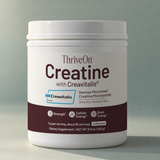
Stronger puts 5 grams of Creavitalis® creatine and 3 grams of marine tripeptide collagen in one daily sachet. Prefer to start with creatine alone? ThriveOn Creatine is the same creatine and nothing else. Subscriptions ship free.


FAQ
Can I take creatine and collagen together?
Yes. Nothing in the research suggests either one interferes with the other, so you can take them at the same time, even in the same glass. The usual daily amounts are 3 to 5g of creatine and 1 to 15g of collagen peptides, depending on the type. Stronger puts both in one daily sachet.
When is the best time to take collagen and creatine?
At whatever time you will take them every day, rest days included. If you want a default, have them with a meal: creatine taken with carbohydrate and protein is retained better. Small studies lean slightly toward taking creatine after training, but reviews find the evidence too weak to make timing a rule, and no collagen trial we found tested one time of day against another.
What are the benefits of combining creatine and collagen?
Creatine supports cellular energy for muscle and brain and, with regular training, strength and lean muscle. Collagen supports skin, joints, tendons and connective tissue.
Can I mix creatine and collagen in coffee?
Yes. Creatine and collagen both stir into coffee or any drink of choice, and so does a Stronger sachet. ThriveOn Creatine is unflavored, so your coffee still tastes like coffee. Research on caffeine and creatine is mixed. One study that found caffeine blunted creatine's benefit had people loading about 35 to 40g of creatine a day with roughly four cups' worth of caffeine, a very different routine from one 5g serving. If the pairing ever unsettles your stomach, take them at different times of day.
How long until I notice results?
At 5g a day, muscle creatine stores fill in about three to four weeks (sooner with a loading week), and strength changes build with training after that. Most collagen skin trials ran 8 to 12 weeks. Give both about 12 weeks of daily use before you judge them.
I already take collagen. Should I switch?
Check your label. If it doesn't specify "tripeptide" or low molecular weight, it is likely a conventional hydrolysate, which trials ran at higher daily amounts. Marine tripeptide collagen is studied for efficient uptake at lower doses.
Do I still need to lift weights?
Yes. Resistance training creates the mechanical signal for bone and muscle adaptation. Creatine and collagen provide the raw materials to answer that signal. Supplementation makes training work harder. It doesn't replace it.
Is creatine safe for women in perimenopause and menopause?
Yes. Research shows creatine is safe and beneficial for women, particularly during perimenopause and menopause when natural creatine stores decline. Quality matters: research-grade creatine avoids the bloating and digestive issues associated with commodity-grade products.
Can I take creatine and collagen with HRT or other medications?
Nothing in the research we reviewed shows an interaction between HRT and creatine or collagen peptides, and a 2026 review of seven major drug-interaction databases found no established interactions of moderate or high severity for creatine. Check with your doctor before you start, as you would with any supplement alongside a prescription.
Is this just for athletes?
No. The women who benefit most are navigating the hormonal transitions of midlife: fatigue, fog, joint changes, and shifts in body composition. You don't need to be an athlete. You need to be in the window where intervention matters.
References
- Kim DU, Chung HC, Choi J, Sakai Y, Lee BY. Oral Intake of Low-Molecular-Weight Collagen Peptide Improves Hydration, Elasticity, and Wrinkling in Human Skin: A Randomized, Double-Blind, Placebo-Controlled Study. Nutrients. 2018;10(7):826.
- Proksch E, Segger D, Degwert J, Schunck M, Zague V, Oesser S. Oral supplementation of specific collagen peptides has beneficial effects on human skin physiology: a double-blind, placebo-controlled study. Skin Pharmacol Physiol. 2014;27(1):47-55.
- Rawson ES, Miles MP, Larson-Meyer DE. Dietary Supplements for Health, Adaptation, and Recovery in Athletes. Int J Sport Nutr Exerc Metab. 2018;28(2):188-199.
- Smith-Ryan AE, Cabre HE, Eckerson JM, Candow DG. Creatine Supplementation in Women's Health: A Lifespan Perspective. Nutrients. 2021;13(3):877.
- Avgerinos KI, Spyrou N, Bougioukas KI, Kapogiannis D. Effects of creatine supplementation on cognitive function of healthy individuals: A systematic review of randomized controlled trials. Exp Gerontol. 2018;108:166-173.
- Brincat M, Moniz CJ, Studd JW, et al. Long-term effects of the menopause and sex hormones on skin thickness. Br J Obstet Gynaecol. 1985;92(3):256-259.
- Varani J, Dame MK, Rittie L, et al. Decreased collagen production in chronologically aged skin: roles of age-dependent alteration in fibroblast function and defective mechanical stimulation. Am J Pathol. 2006;168(6):1861-1868.
- Candow DG, Forbes SC, Chilibeck PD, Cornish SM, Antonio J, Kreider RB. Effectiveness of Creatine Supplementation on Aging Muscle and Bone: Focus on Falls Prevention and Inflammation. J Clin Med. 2019;8(4):488.
- König D, Oesser S, Scharla S, Zdzieblik D, Gollhofer A. Specific Collagen Peptides Improve Bone Mineral Density and Bone Markers in Postmenopausal Women: A Randomized Controlled Study. Nutrients. 2018;10(1):97.
- Ohara H, Matsumoto H, Ito K, Iwai K, Sato K. Comparison of quantity and structures of hydroxyproline-containing peptides in human blood after oral ingestion of gelatin hydrolysates from different sources. J Agric Food Chem. 2007;55(4):1532-1535.
- Pullar JM, Carr AC, Vissers MCM. The Roles of Vitamin C in Skin Health. Nutrients. 2017;9(8):866.
- Schaffer S, Kim HW. Effects and Mechanisms of Taurine as a Therapeutic Agent. Biomol Ther (Seoul). 2018;26(3):225-241.
- Anghelescu IG, Edwards D, Seifritz E, Kasper S. Stress management and the role of Rhodiola rosea: a review. Int J Psychiatry Clin Pract. 2018;22(4):242-252.
- Maresz K. Proper Calcium Use: Vitamin K2 as a Promoter of Bone and Cardiovascular Health. Integr Med (Encinitas). 2015;14(1):34-39.
- Rae C, Digney AL, McEwan SR, Bates TC. Oral creatine monohydrate supplementation improves brain performance: a double-blind, placebo-controlled, cross-over trial. Proc Biol Sci. 2003;270(1529):2147-2150.
- Kreider RB, Kalman DS, Antonio J, et al. International Society of Sports Nutrition position stand: safety and efficacy of creatine supplementation in exercise, sport, and medicine. J Int Soc Sports Nutr. 2017;14:18.
- Hultman E, Söderlund K, Timmons JA, Cederblad G, Greenhaff PL. Muscle creatine loading in men. J Appl Physiol. 1996;81(1):232-237.
- Steenge GR, Simpson EJ, Greenhaff PL. Protein- and carbohydrate-induced augmentation of whole body creatine retention in humans. J Appl Physiol. 2000;89(3):1165-1171.
- Ribeiro F, Longobardi I, Perim P, et al. Timing of Creatine Supplementation around Exercise: A Real Concern? Nutrients. 2021;13(8):2844.
- Jäger R, Purpura M, Shao A, Inoue T, Kreider RB. Analysis of the efficacy, safety, and regulatory status of novel forms of creatine. Amino Acids. 2011;40(5):1369-1383.
- Vandenberghe K, Gillis N, Van Leemputte M, et al. Caffeine counteracts the ergogenic action of muscle creatine loading. J Appl Physiol. 1996;80(2):452-457.
- Elosegui S, López-Seoane J, Martínez-Ferrán M, Pareja-Galeano H. Interaction Between Caffeine and Creatine When Used as Concurrent Ergogenic Supplements: A Systematic Review. Int J Sport Nutr Exerc Metab. 2022;32(4):285-295.
- de Souza e Silva A, Pertille A, Reis Barbosa CG, et al. Effects of Creatine Supplementation on Renal Function: A Systematic Review and Meta-Analysis. J Ren Nutr. 2019;29(6):480-489.
- Ostojic SM. Potential interactions between creatine supplementation and prescription drugs: a narrative review and evidence-mapping perspective. Curr Ther Res Clin Exp. 2026;105:100844.
- Hsu T, Sung H, Yeh M, et al. Oral supplementation of tripeptides (MAXI Collagen) rapidly enhances collagen in human skin within 7 days: a double-blind, placebo-controlled study. J Curr Synth Syst Bio. 2025;13:122. ClinicalTrials.gov NCT06194487. Conducted by the ingredient's manufacturer.


